McIntosh MA2375 Vacuum Tube Integrated Amplifier
McIntosh hasn't made a new all-tube integrated amplifier in over ten years. The new MA2375 changes that, and at 93 pounds and $15,000, it's exactly the kind of thing McIntosh does better than almost anyone else.
Why McIntosh Commands This Kind of Money
Before getting into the MA2375 specifically, it's worth understanding why McIntosh as a company matters, because it's directly relevant to why this amplifier exists and why people spend this kind of money on it. They've been building amplifiers in Binghamton, New York since 1949, their gear powered the Grateful Dead's Wall of Sound, and they've been a fixture in serious listening rooms ever since. We've visited the factory several times and what stands out is how much they manufacture in-house, including the output transformers, and how clearly everything is built to last for decades rather than years.

How the MA2375 Differs from McIntosh's Hybrid Integrateds
If you've followed our McIntosh content before, you know we're big fans of their hybrid integrated amplifiers, the MA252 and the MA352. Both of those use vacuum tubes in the preamplifier section paired with a solid-state output stage, which gives you tube warmth in the midrange alongside the control and power that solid-state delivers at the low end. It's a great combination and one we still recommend to a lot of people.
The MA2375 is different. With a hybrid, the tube character comes from the preamp stage and then hands off to transistors to do the heavy lifting. Here the tubes are doing everything, including driving the speakers, which means their harmonic character runs through the entire signal chain. That's what gives a great all-tube amplifier its particular quality, a richness and dimensionality that's hard to get any other way.
Tube Complement: What's Inside the MA2375
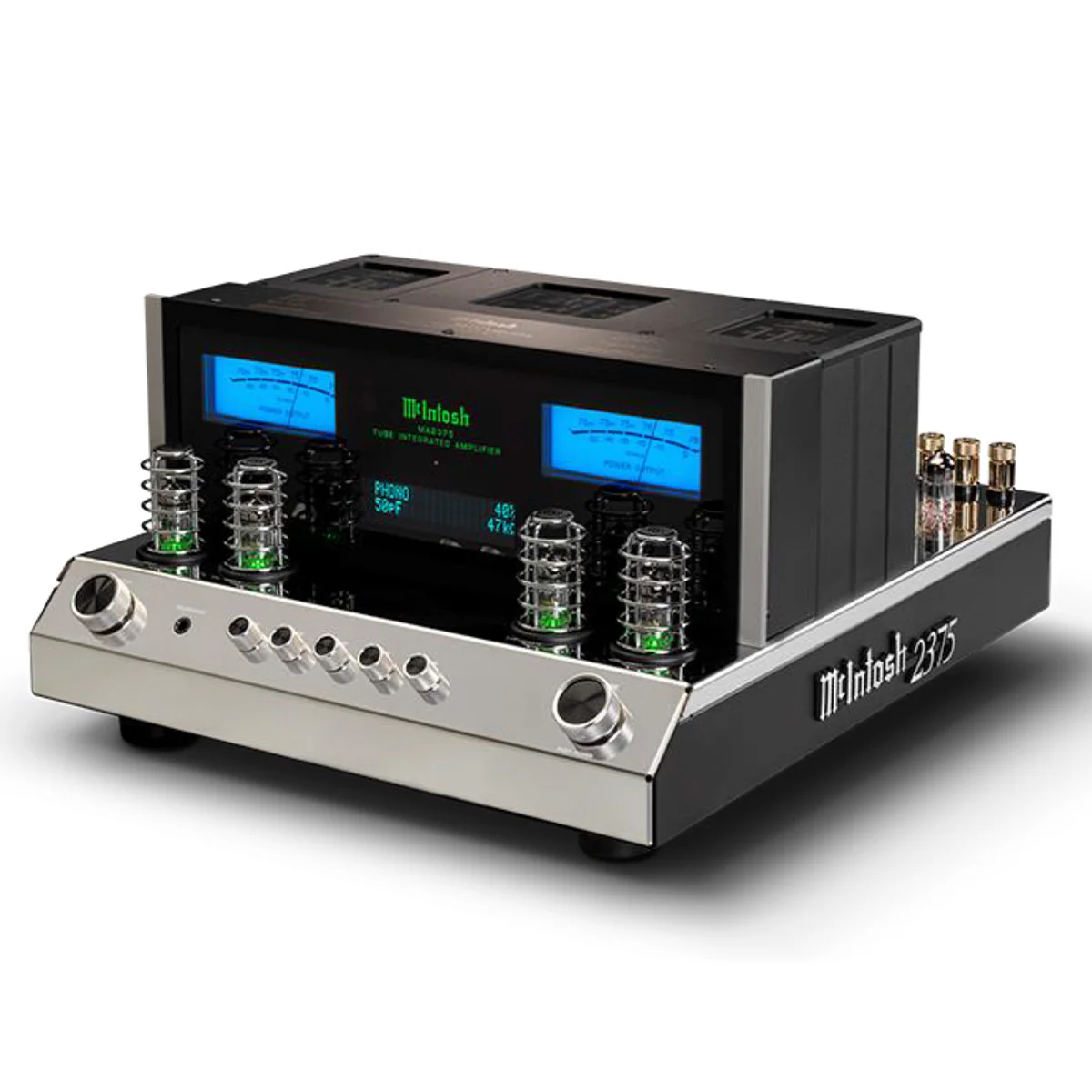
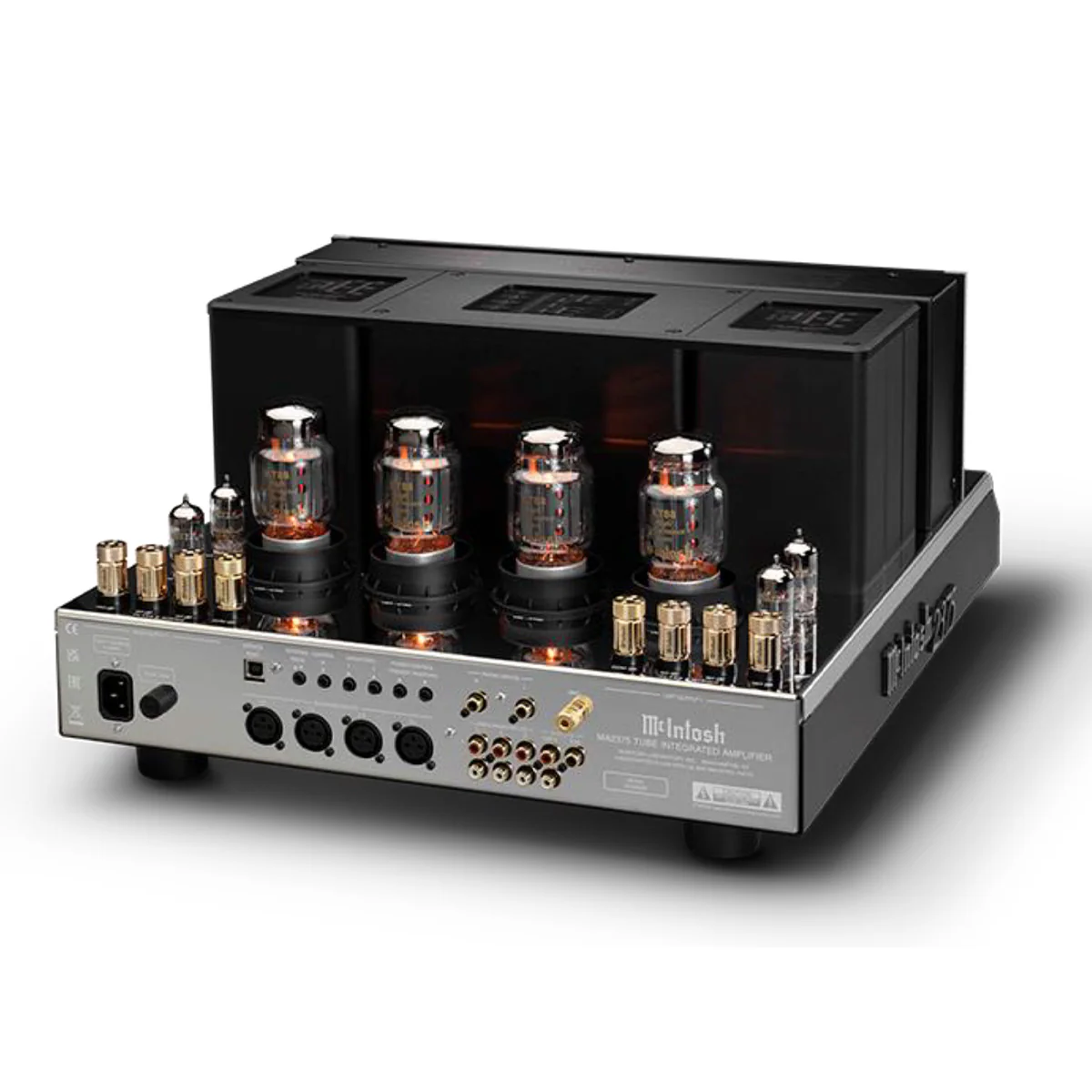
So how many tubes are we actually talking about? Twelve in total. The front of the chassis handles the preamplifier section with two 12AX7A and two 12AT7 tubes. In the rear, behind a protective cage, the power amplifier section uses four 12AT7 driver tubes and four KT88 output tubes. The KT88 is a large-bottle tube with a long track record in serious audio, known for delivering real power with low distortion and a tonal richness that smaller output tubes tend not to reach. Two of them per channel is also what gives the MA2375 its 75 watts per channel rating, which for a tube integrated is a substantial amount of power and more than enough to drive a wide range of speakers with authority. And when you power it on, the front preamp tubes glow orange during warmup and settle into green when the amp is ready to play, which adds something to the whole experience of owning this amplifier that goes beyond just the sound.

Design and Build Quality
Let's talk about the build, because this thing is a statement. The chassis is satin black on top with a polished stainless steel fascia up front, and that gothic McIntosh 2375 script badge running across each side is one of those details that makes it unmistakable from across the room. The dual blue power meters flank the tube section on either side, the preamp tubes in the front each have their own individual cage covers, and the four KT88 output tubes in the rear sit behind a large protective cage that lifts off if you want them fully exposed. It's the kind of piece that earns a dedicated spot in a room rather than getting tucked away in a cabinet, and honestly most people who see it for the first time want to know what it is before they even hear it. The controls are solid and tactile, the volume knob has that smooth precise feel you want at this price. Everything about it feels built to last, which for McIntosh is really just par for the course.
One practical note worth mentioning: the MA2375 generates real heat running all those KT88s, and McIntosh specifies at least 19 inches of clearance above the unit. This is not an amplifier for an enclosed cabinet. Plan for an open rack or a dedicated stand where the heat has somewhere to go.
Unity Coupled Circuit Output Transformers
One of the things that makes the MA2375 more practical than most all-tube amplifiers is the Unity Coupled Circuit Output Transformers. In a tube power amplifier, the output transformer is one of the most critical components in the signal chain. It's what bridges the tube's output impedance to your speaker, and a poorly designed one is one of the fastest ways to undermine an otherwise good tube design.
McIntosh has been refining their Unity Coupled transformers for decades, and what sets them apart is that the MA2375 delivers its full rated 75 watts per channel into 4, 8, or 16 ohm speakers. Most tube amplifiers are rated at one impedance and deliver less power when you move to a different tap. With the Unity Coupled design you connect your cables to the posts that match your speaker's impedance and you're getting everything the amplifier has to offer regardless of which tap you're on.
Tube Protection: Power Guard Screen Grid Sensor and Sentry Monitor
One of the most common concerns around all-tube amplifiers is what happens to the output tubes when you push the amp too hard. McIntosh has a specific answer to that with Power Guard Screen Grid Sensor, which is different from the Power Guard system on their solid-state amplifiers. This one continuously monitors the current flowing through the screen grids of the KT88 output tubes, and if that current climbs to unsafe levels, it dynamically attenuates the input signal to keep the tubes in a safe operating range. That works alongside Sentry Monitor, McIntosh's fuse-less short-circuit protection that shuts down the MA2375 if it detects a short in the speaker cables or an impedance mismatch. Together, these two systems make the MA2375 a much more forgiving thing to own over the long term than most all-tube amplifiers on the market.

Inputs, Outputs, and Connectivity
The MA2375 has six analog inputs: three unbalanced, two balanced, and a universal phono input configurable for Moving Magnet, Low Output Moving Coil, and High Output Moving Coil cartridges directly from the front panel. You can adjust Gain, Capacitance, and Resistance Loading to match your specific cartridge, which is a level of control that usually requires a dedicated outboard phono stage.
There is also a subwoofer output, a Home Theater PassThru, and on the speaker side McIntosh's patented Solid Cinch binding posts, which are gold-plated and designed to hold your cables securely without loosening over time. It's the kind of detail that matters when you're running quality cables on a $15,000 amplifier. We have a full video on home theater bypass if you want to go deeper on that feature, but it's worth knowing it's there.
One thing worth being clear about: the MA2375 is a fully analog amplifier with no digital inputs and no built-in DAC. If your music lives primarily on a streaming service, you'll need a separate streamer feeding into one of the analog inputs. If you're a vinyl person, the phono stage is built in and handles all three cartridge types, though it is a solid-state circuit rather than tubes. That's worth knowing if you're a die-hard tube purist, but the reasoning is sound. The tube character in this amplifier lives in the line-level preamp and power amplifier sections, which is where it has the most impact on what you actually hear.
Five-Band Equalizer
The five-band EQ sits at 30Hz, 125Hz, 500Hz, 2,000Hz, and 10,000Hz. That's a useful spread that lets you address bass buildup in a room, tame a speaker that's a little forward in the presence region, or dial in the top end to your taste. And if you'd rather keep things pure, there's a bypass function that takes it completely out of the signal path.
Headphone Output with HXD
The headphone output is a High Drive amplifier with McIntosh's Headphone Crossfeed Director, or HXD. The signal passes through the tube preamp section before reaching the headphone amp, so you get the tube character through your headphones as well. HXD blends a small amount of each channel into the other to simulate the way sound from speakers reaches both ears naturally, rather than the hard left-right separation you get with most headphone listening. Our team is split on it, some of us like what it does to the soundstage, others prefer it off. It's a one-button toggle either way so it's never in your way.

Power Rating and Speaker Matching
It's easy to look at 75 watts and compare it to the 200-watt output on the MA352 and assume the MA2375 is the lesser amplifier. In some situations it is, and we think it's worth knowing that going in. If you're running speakers below around 87 or 88 dB sensitivity in a large room and you like to play music loud, you may find yourself running out of headroom, and the MA352 or a separate power amplifier would probably serve you better in that scenario. But for most listeners in most rooms with speakers that make sense alongside an all-tube design, 75 watts from KT88s through Unity Coupled Transformers is plenty. They're clean, controlled watts, and in a well-matched system this amplifier fills a room without any sense of strain.
Frequently Asked Questions
What is the McIntosh MA2375? The MA2375 is McIntosh's first all-tube integrated amplifier in over a decade. Both the preamplifier and power amplifier sections run entirely on vacuum tubes, delivering 75 watts per channel through four KT88 output tubes.
How does the MA2375 differ from the MA352? The MA352 is a hybrid integrated amplifier that uses tubes in the preamplifier section and a solid-state output stage. The MA2375 runs tubes throughout the entire signal chain including the power amplifier section. The MA352 also outputs 200 watts per channel compared to the MA2375's 75 watts.
Does the McIntosh MA2375 have a DAC or streaming capability? No. The MA2375 is a fully analog amplifier with no digital inputs and no built-in DAC. Users who stream music will need a separate streamer or DAC connected to one of the six analog inputs.
Does the MA2375 work with a turntable? Yes. The MA2375 includes a universal phono stage supporting Moving Magnet, Low Output Moving Coil, and High Output Moving Coil cartridges, with adjustable Gain, Capacitance, and Resistance Loading. The phono stage is a solid-state circuit.
What speakers work best with the McIntosh MA2375? Speakers with a sensitivity of 87 dB or higher pair most naturally with the MA2375's 75-watt output. Lower-sensitivity speakers in large rooms may benefit from a higher-powered amplifier.
How much clearance does the MA2375 need? McIntosh specifies a minimum of 19 inches of clearance above the unit. The KT88 output tubes generate significant heat and the MA2375 should not be placed in an enclosed cabinet.

Overall Recommendation
The MA2375 is for someone who wants the complete tube experience without having to build a separates system from scratch. It's for vinyl listeners who need a serious, configurable phono stage built in. It's for people who want something that McIntosh will still support and service twenty years from now, which given their track record is a very safe bet. And it's for anyone who has heard a great all-tube amplifier and decided that's the sound they want at the center of everything they listen to. This is not an amplifier for someone chasing specs or trying to hear every clinical detail in a recording. It's for the enjoyment of music, full stop. At $15,000 it's a serious investment, but given what you're getting and who's making it, that's a hard price to argue with.
We’re Here to Help!
If you have further questions, contact our experts via chat, phone, or email. Or simply visit one of our world-class showrooms to experience speakers, projectors, TVs, and everything in between for yourself before you make a purchase!
If you’re planning your home theater or media room, check out our Home Theater Design page, where we have everything Home Theater related, including our FREE Home Theater Design Tool.
When you buy from Audio Advice, you’re buying from a trusted seller since 1978. We offer Free Shipping, Lifetime Expert Support, and our Price Guarantee. We look forward to serving you!
Original: $15,000.00
-65%$15,000.00
$5,250.00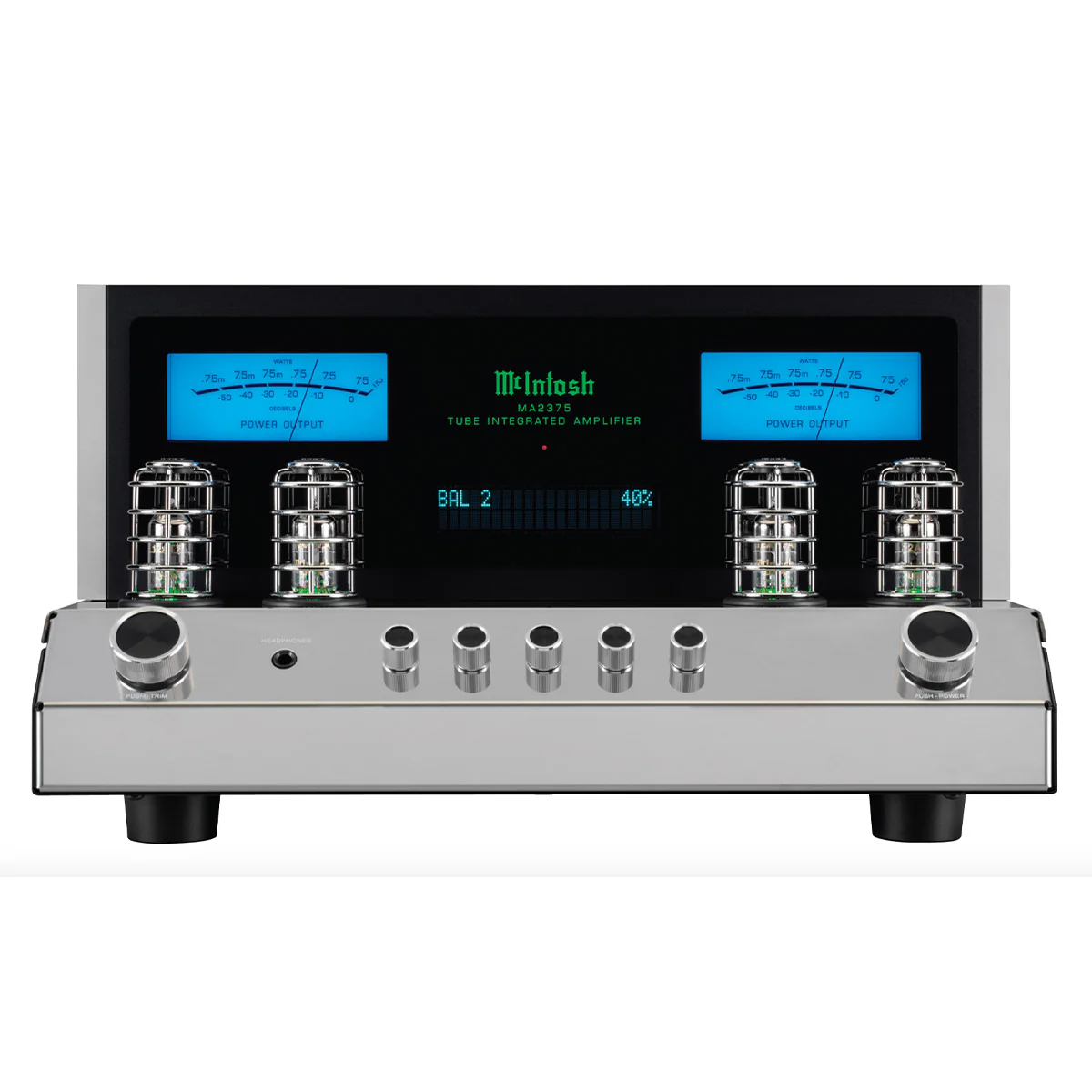
Description
McIntosh hasn't made a new all-tube integrated amplifier in over ten years. The new MA2375 changes that, and at 93 pounds and $15,000, it's exactly the kind of thing McIntosh does better than almost anyone else.
Why McIntosh Commands This Kind of Money
Before getting into the MA2375 specifically, it's worth understanding why McIntosh as a company matters, because it's directly relevant to why this amplifier exists and why people spend this kind of money on it. They've been building amplifiers in Binghamton, New York since 1949, their gear powered the Grateful Dead's Wall of Sound, and they've been a fixture in serious listening rooms ever since. We've visited the factory several times and what stands out is how much they manufacture in-house, including the output transformers, and how clearly everything is built to last for decades rather than years.
How the MA2375 Differs from McIntosh's Hybrid Integrateds
If you've followed our McIntosh content before, you know we're big fans of their hybrid integrated amplifiers, the MA252 and the MA352. Both of those use vacuum tubes in the preamplifier section paired with a solid-state output stage, which gives you tube warmth in the midrange alongside the control and power that solid-state delivers at the low end. It's a great combination and one we still recommend to a lot of people.
The MA2375 is different. With a hybrid, the tube character comes from the preamp stage and then hands off to transistors to do the heavy lifting. Here the tubes are doing everything, including driving the speakers, which means their harmonic character runs through the entire signal chain. That's what gives a great all-tube amplifier its particular quality, a richness and dimensionality that's hard to get any other way.
Tube Complement: What's Inside the MA2375
So how many tubes are we actually talking about? Twelve in total. The front of the chassis handles the preamplifier section with two 12AX7A and two 12AT7 tubes. In the rear, behind a protective cage, the power amplifier section uses four 12AT7 driver tubes and four KT88 output tubes. The KT88 is a large-bottle tube with a long track record in serious audio, known for delivering real power with low distortion and a tonal richness that smaller output tubes tend not to reach. Two of them per channel is also what gives the MA2375 its 75 watts per channel rating, which for a tube integrated is a substantial amount of power and more than enough to drive a wide range of speakers with authority. And when you power it on, the front preamp tubes glow orange during warmup and settle into green when the amp is ready to play, which adds something to the whole experience of owning this amplifier that goes beyond just the sound.
Design and Build Quality
Let's talk about the build, because this thing is a statement. The chassis is satin black on top with a polished stainless steel fascia up front, and that gothic McIntosh 2375 script badge running across each side is one of those details that makes it unmistakable from across the room. The dual blue power meters flank the tube section on either side, the preamp tubes in the front each have their own individual cage covers, and the four KT88 output tubes in the rear sit behind a large protective cage that lifts off if you want them fully exposed. It's the kind of piece that earns a dedicated spot in a room rather than getting tucked away in a cabinet, and honestly most people who see it for the first time want to know what it is before they even hear it. The controls are solid and tactile, the volume knob has that smooth precise feel you want at this price. Everything about it feels built to last, which for McIntosh is really just par for the course.
One practical note worth mentioning: the MA2375 generates real heat running all those KT88s, and McIntosh specifies at least 19 inches of clearance above the unit. This is not an amplifier for an enclosed cabinet. Plan for an open rack or a dedicated stand where the heat has somewhere to go.
Unity Coupled Circuit Output Transformers
One of the things that makes the MA2375 more practical than most all-tube amplifiers is the Unity Coupled Circuit Output Transformers. In a tube power amplifier, the output transformer is one of the most critical components in the signal chain. It's what bridges the tube's output impedance to your speaker, and a poorly designed one is one of the fastest ways to undermine an otherwise good tube design.
McIntosh has been refining their Unity Coupled transformers for decades, and what sets them apart is that the MA2375 delivers its full rated 75 watts per channel into 4, 8, or 16 ohm speakers. Most tube amplifiers are rated at one impedance and deliver less power when you move to a different tap. With the Unity Coupled design you connect your cables to the posts that match your speaker's impedance and you're getting everything the amplifier has to offer regardless of which tap you're on.
Tube Protection: Power Guard Screen Grid Sensor and Sentry Monitor
One of the most common concerns around all-tube amplifiers is what happens to the output tubes when you push the amp too hard. McIntosh has a specific answer to that with Power Guard Screen Grid Sensor, which is different from the Power Guard system on their solid-state amplifiers. This one continuously monitors the current flowing through the screen grids of the KT88 output tubes, and if that current climbs to unsafe levels, it dynamically attenuates the input signal to keep the tubes in a safe operating range. That works alongside Sentry Monitor, McIntosh's fuse-less short-circuit protection that shuts down the MA2375 if it detects a short in the speaker cables or an impedance mismatch. Together, these two systems make the MA2375 a much more forgiving thing to own over the long term than most all-tube amplifiers on the market.
Inputs, Outputs, and Connectivity
The MA2375 has six analog inputs: three unbalanced, two balanced, and a universal phono input configurable for Moving Magnet, Low Output Moving Coil, and High Output Moving Coil cartridges directly from the front panel. You can adjust Gain, Capacitance, and Resistance Loading to match your specific cartridge, which is a level of control that usually requires a dedicated outboard phono stage.
There is also a subwoofer output, a Home Theater PassThru, and on the speaker side McIntosh's patented Solid Cinch binding posts, which are gold-plated and designed to hold your cables securely without loosening over time. It's the kind of detail that matters when you're running quality cables on a $15,000 amplifier. We have a full video on home theater bypass if you want to go deeper on that feature, but it's worth knowing it's there.
One thing worth being clear about: the MA2375 is a fully analog amplifier with no digital inputs and no built-in DAC. If your music lives primarily on a streaming service, you'll need a separate streamer feeding into one of the analog inputs. If you're a vinyl person, the phono stage is built in and handles all three cartridge types, though it is a solid-state circuit rather than tubes. That's worth knowing if you're a die-hard tube purist, but the reasoning is sound. The tube character in this amplifier lives in the line-level preamp and power amplifier sections, which is where it has the most impact on what you actually hear.
Five-Band Equalizer
The five-band EQ sits at 30Hz, 125Hz, 500Hz, 2,000Hz, and 10,000Hz. That's a useful spread that lets you address bass buildup in a room, tame a speaker that's a little forward in the presence region, or dial in the top end to your taste. And if you'd rather keep things pure, there's a bypass function that takes it completely out of the signal path.
Headphone Output with HXD
The headphone output is a High Drive amplifier with McIntosh's Headphone Crossfeed Director, or HXD. The signal passes through the tube preamp section before reaching the headphone amp, so you get the tube character through your headphones as well. HXD blends a small amount of each channel into the other to simulate the way sound from speakers reaches both ears naturally, rather than the hard left-right separation you get with most headphone listening. Our team is split on it, some of us like what it does to the soundstage, others prefer it off. It's a one-button toggle either way so it's never in your way.
Power Rating and Speaker Matching
It's easy to look at 75 watts and compare it to the 200-watt output on the MA352 and assume the MA2375 is the lesser amplifier. In some situations it is, and we think it's worth knowing that going in. If you're running speakers below around 87 or 88 dB sensitivity in a large room and you like to play music loud, you may find yourself running out of headroom, and the MA352 or a separate power amplifier would probably serve you better in that scenario. But for most listeners in most rooms with speakers that make sense alongside an all-tube design, 75 watts from KT88s through Unity Coupled Transformers is plenty. They're clean, controlled watts, and in a well-matched system this amplifier fills a room without any sense of strain.
Frequently Asked Questions
What is the McIntosh MA2375? The MA2375 is McIntosh's first all-tube integrated amplifier in over a decade. Both the preamplifier and power amplifier sections run entirely on vacuum tubes, delivering 75 watts per channel through four KT88 output tubes.
How does the MA2375 differ from the MA352? The MA352 is a hybrid integrated amplifier that uses tubes in the preamplifier section and a solid-state output stage. The MA2375 runs tubes throughout the entire signal chain including the power amplifier section. The MA352 also outputs 200 watts per channel compared to the MA2375's 75 watts.
Does the McIntosh MA2375 have a DAC or streaming capability? No. The MA2375 is a fully analog amplifier with no digital inputs and no built-in DAC. Users who stream music will need a separate streamer or DAC connected to one of the six analog inputs.
Does the MA2375 work with a turntable? Yes. The MA2375 includes a universal phono stage supporting Moving Magnet, Low Output Moving Coil, and High Output Moving Coil cartridges, with adjustable Gain, Capacitance, and Resistance Loading. The phono stage is a solid-state circuit.
What speakers work best with the McIntosh MA2375? Speakers with a sensitivity of 87 dB or higher pair most naturally with the MA2375's 75-watt output. Lower-sensitivity speakers in large rooms may benefit from a higher-powered amplifier.
How much clearance does the MA2375 need? McIntosh specifies a minimum of 19 inches of clearance above the unit. The KT88 output tubes generate significant heat and the MA2375 should not be placed in an enclosed cabinet.
Overall Recommendation
The MA2375 is for someone who wants the complete tube experience without having to build a separates system from scratch. It's for vinyl listeners who need a serious, configurable phono stage built in. It's for people who want something that McIntosh will still support and service twenty years from now, which given their track record is a very safe bet. And it's for anyone who has heard a great all-tube amplifier and decided that's the sound they want at the center of everything they listen to. This is not an amplifier for someone chasing specs or trying to hear every clinical detail in a recording. It's for the enjoyment of music, full stop. At $15,000 it's a serious investment, but given what you're getting and who's making it, that's a hard price to argue with.
We’re Here to Help!
If you have further questions, contact our experts via chat, phone, or email. Or simply visit one of our world-class showrooms to experience speakers, projectors, TVs, and everything in between for yourself before you make a purchase!
If you’re planning your home theater or media room, check out our Home Theater Design page, where we have everything Home Theater related, including our FREE Home Theater Design Tool.
When you buy from Audio Advice, you’re buying from a trusted seller since 1978. We offer Free Shipping, Lifetime Expert Support, and our Price Guarantee. We look forward to serving you!